
Screen Time Reality Check: What Digital Detox Assessments Reveal
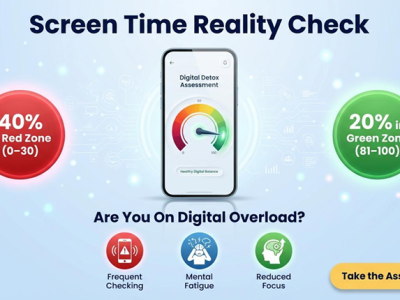
In a world where smartphones are always within reach, most people believe they are in control of their screen habits. But our data tells a different story. After analyzing Digital Detox Assessments, clear and consistent patterns have emerged about modern screen time behavior, digital addiction risk, and digital wellbeing. And the results are eye-opening.
Digital Detox Assessment Results Breakdown
Based on collected responses:
🔴 40% fall into the Red Zone (0–30)
⚫🔵 40% fall into the Middle Zone (31–80)
A mere 20% achieved a Green Zone score (81–100)
This means 80% of individuals are not fully in control of their digital habits. Let’s understand what that means.
40% Show Signs of Digital Overload
Individuals in the Red Zone demonstrate common signs of smartphone addiction and digital
overuse:
● Frequent phone checking
● Compulsive social media scrolling
● Difficulty staying offline
● Not tracking screen time
● Anxiety or discomfort when away from the phone
● Reduced focus and mental fatigues leo.
What’s concerning is that many participants did not initially believe their screen time habits were unhealthy.althy.
Digital overload doesn’t feel extreme.It feels normal – because constant connectivity has become normalized.
Over time, this leads to:
● Reduced productivity
● Shorter attention span
● Emotional exhaustion
● Poor sleep quality
● Increased stress levels
⚫🔵 The Middle 40%: The Silent Risk Zone
● This segment is the most important.
● They are not severely addicted.
● But they are not fully in control either.
● This is where gradual digital dependency develops.
It builds quietly:
● During short breaks
● Between tasks
● While waiting
● Before sleeping
● Immediately after waking up
● The danger isn’t obvious.
The impact appears later as:
● Scattered attention
● Reduced deep work capacity
● Mental clutter
● Constant distraction
Without awareness, this group can easily shift toward unhealthy digital patterns.
Only 20% Practice Healthy Digital Boundaries
The Green Zone represents individuals who:
● Use technology intentionally
● Set digital limits
● Track their screen time
● Avoid mindless scrolling
● Maintain sustained focus
● Feel comfortable being offline
They treat technology as a tool – not a constant stimulation source. Their digital wellbeing practices protect their productivity and mental clarity.
Why Screen Time Awareness Matters
Most people underestimate how often they check their phones. Self-perception rarely matches actual behavior. That’s why a Digital Detox Assessment is powerful.
It provides:
● Objective screen time awareness
● Insight into phone usage patterns
● Early detection of digital addiction signs
● A starting point for reducing screen time
● The goal is not to eliminate technology.
● The goal is to regain control.
● Awareness is the first step toward digital balance.
Signs You May Need a Digital Detox
Ask yourself:
● Do you check your phone without any reason?
● Do you feel restless when you can’t access social media?
● Do you lose track of time while scrolling?
● Is your focus weaker than it used to be?
● Do you struggle with digital boundaries?
If you answered yes to multiple questions, it may be time for a screen time reality check.
Take the Digital Detox Assessment
You don’t have to guess where you stand.
● Measure it.
● Understand it.
● Improve it.
Take the Digital Detox Assessment today and discover your digital score. Because what you measure, you can manage.
FAQ
What is a Digital Detox Assessment?
A Digital Detox Assessment is a structured evaluation that measures your screen time habits, phone
dependency level, and overall digital wellbeing.
Am I addicted to my phone? How can I know?
Common signs include constant phone checking, anxiety without your device, compulsive scrolling,
and reduced focus.
How much screen time is too much?
While usage varies by lifestyle, excessive recreational screen time combined with reduced
productivity and mental fatigue may indicate digital overload.
Can reducing screen time improve focus?
Yes. Limiting distractions and creating digital boundaries significantly improves concentration, productivity, and mental clarity.
How can I start a digital detox?
Begin by tracking screen time, setting daily limits, turning off non-essential notifications, and scheduling device-free time.