
General Digital Detox Report vs Personalized Digital Behaviour Report
Technology has become a central part of modern life. Smartphones, social media platforms, and constant notifications influence how we work, communicate, and spend our time.
Many people now realize that excessive screen usage can affect productivity, focus, sleep, and mental wellbeing. As a result, interest in digital detox reports and digital behaviour assessments has grown rapidly.
However, not all digital detox reports provide the same level of insight.
Some offer general recommendations, while others analyze personal digital behaviour patterns to provide meaningful, data-driven guidance.
Understanding the difference between a General Digital Detox Report and a Personalized Digital Behaviour Report is essential if you want to truly improve your digital habits.
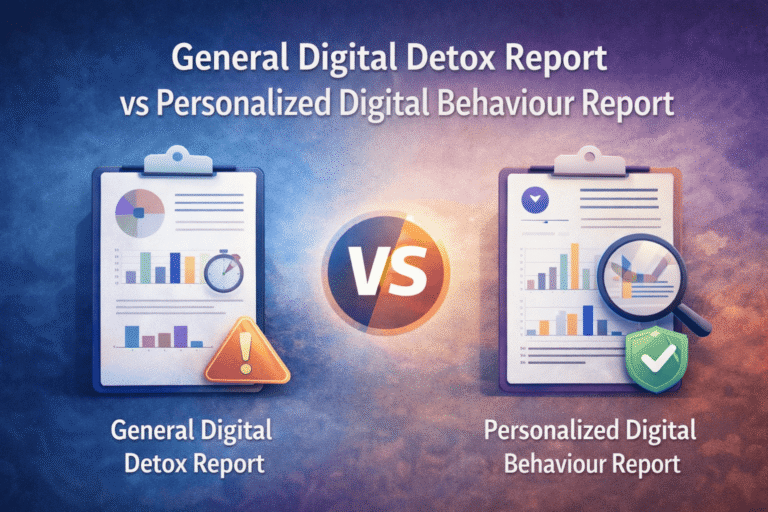
What Is a General Digital Detox Report?
A general digital detox report usually focuses on awareness and education about healthy technology use.
- These reports provide general tips such as:
- Reduce overall screen time
- Limit social media usage
- Avoid using phones before bedtime
- Take regular breaks from devices
- Practice mindful use of technology
While these suggestions are helpful, they are not personalized.
A general report typically does not analyze:
- Your daily screen usage patterns
- Your phone checking behaviour
- Your social media dependency
- Your emotional response to digital interactions
- Your digital productivity habits
In simple terms, a general report explains what people should do, but it does not explain how their personal digital behaviour actually works.
What Is a Personalized Digital Behaviour Report?
A personalized digital behaviour report goes much deeper than general advice.
Instead of providing broad suggestions, it evaluates an individual’s digital habits through a structured digital detox assessment.
This type of report measures multiple aspects of technology usage, including:
- Screen time patterns
- Phone checking behaviour
- Social media engagement
- Emotional reactions to digital content
- Productivity and focus patterns
By analyzing these factors, the report provides specific insights into how technology influences a person’s daily routine and mental focus.
Key Behaviour Indicators Measured in Digital Detox Assessments
A structured digital detox assessment often evaluates several important digital behaviour indicators.
Below are some of the most important ones.
1. Daily Screen Time Patterns
One of the strongest indicators of digital dependency is how many hours a person spends on screens every day.
Many people underestimate their screen usage until they actually measure it.
Tracking screen time reveals:
- Total daily screen exposure
- Most frequently used apps
- Time spent on social media
- Usage patterns during the day
For many individuals, screen exposure can exceed 6 hours per day, often without conscious awareness.
Understanding this pattern is the first step toward improving digital discipline.
2. Phone Checking Behaviour
Another important digital behaviour pattern is how frequently people check their phones.
A common indicator of digital dependency is checking the phone immediately after waking up.
This habit may suggest:
- Increased digital dependency
- Reduced morning focus
- Immediate exposure to digital distractions
People who avoid phone usage during the first hour of the day often show better digital discipline and stronger morning productivity.
3. Screen Time Awareness
Another factor evaluated in digital behaviour reports is whether individuals actively track their screen usage.
Some people regularly monitor their screen time through device reports or apps.
Others have no idea how much time they spend online.
When someone does not track their screen time, it often indicates low awareness of digital habits, which can lead to unconscious overuse.
4. Social Media Usage Patterns
Social media platforms play a major role in digital behaviour.
Digital detox assessments often analyze:
- How frequently social media is checked
- Whether social media affects mood
- How much time is spent scrolling
Frequent social media checking can contribute to:
- Attention fragmentation
- Reduced focus
- Increased digital distraction
In contrast, individuals who check social media less frequently often demonstrate better attention control and healthier digital boundaries.
5. Emotional Impact of Digital Platforms
Technology also influences emotional wellbeing.
One key behaviour pattern measured in assessments is FOMO (Fear of Missing Out).
FOMO occurs when individuals feel anxious or pressured after seeing what others are doing online.
This emotional response can lead to:
- Excessive social media checking
- Increased digital stress
- Reduced self-focus and productivity
Understanding this emotional dimension helps people build a healthier relationship with digital platforms.
Digital Detox Score Categories
After evaluating digital behaviour patterns, the Digital Detox Assessment generates an overall digital detox score. This score helps classify digital habits into four different categories, making it easier for individuals to understand their relationship with technology.
The scoring system is designed to show whether someone has healthy digital discipline, moderate usage, growing dependency, or signs of digital overload.
🟢 Green Zone (81–100) – Healthy Digital Balance
Individuals in the Green Zone demonstrate strong digital discipline and balanced technology usage.
People in this category typically:
- Use technology intentionally rather than habitually
- Maintain healthy boundaries with devices
- Avoid unnecessary scrolling and digital distractions
- Protect deep focus and productivity time
Technology is used as a tool for productivity and communication rather than a constant source of distraction.
🔵 Blue Zone (61–80) – Moderate Digital Usage
People in the Blue Zone generally maintain reasonable control over their digital habits but may experience occasional distractions.
Individuals in this category may:
- Check their phones frequently during the day
- Spend moderate time on social media platforms
- Experience occasional attention interruptions
While their digital habits are not problematic, small improvements in screen discipline can significantly improve productivity and focus.
⚫ Black Zone (31–60) – Attention Risk Zone
The Black Zone represents a growing dependency on digital devices.
Individuals in this category often experience:
- Frequent phone checking throughout the day
- Difficulty maintaining long periods of focus
- Increasing reliance on digital platforms during idle time
Reduced awareness of total screen time usage
At this stage, digital distractions begin to impact productivity, attention span, and mental clarity.
Recognizing this pattern early allows individuals to reset their digital habits before dependency increases further.
🔴 Red Zone (0–30) – Digital Overload Risk
The Red Zone indicates a high level of digital dependency and potential digital overload.
Individuals in this category may experience:
- Compulsive phone checking behaviour
- Excessive social media scrolling
- Constant notifications interrupting focus
- Mental fatigue and reduced productivity
This category often signals that digital habits may be negatively affecting concentration, sleep patterns, and overall wellbeing.
Implementing structured digital detox strategies can help restore balance, focus, and healthier technology usage.
Why These Score Categories Matter
The four-zone scoring system helps individuals quickly understand their digital discipline level and identify whether they need awareness, improvement, or immediate digital habit changes.
By measuring digital behaviour instead of guessing it, people gain clear insights into how technology influences their daily life.
Comparison: General Report vs Personalized Digital Behaviour Report
Feature | General Digital Detox Report | Personalized Digital Behaviour Report |
Advice Type | Generic tips | Personalized insights |
Data Analysis | Not included | Behaviour-based analysis |
Screen Time Tracking | No | Yes |
Social Media Behaviour | General discussion | Individual analysis |
Emotional Impact | Limited | Detailed behavioural insights |
Recommendations | Broad suggestions | Data-driven strategy |
This comparison highlights why personalized reports are far more effective for improving digital habits.
Why Measuring Digital Behaviour Matters
Many people believe they understand their digital habits.
However, perception and reality are often very different.
Without measuring digital behaviour:
- Screen addiction can go unnoticed
- Digital distractions increase
- Productivity decreases
- Mental fatigue grows
Tracking digital behaviour creates awareness.
And awareness is the first step toward building healthier digital habits.
About Rallivika Insights Digital Detox Assessment
Rallivika Insights focuses on helping individuals understand their relationship with technology through data-driven digital behaviour analysis.
The digital detox assessment evaluates several key lifestyle areas, including:
- Screen and app usage patterns
- Social media behaviour
- Sleep and productivity impact
- Mental and physical wellbeing
The goal is to provide individuals with clear insights into their digital habits and practical strategies to improve them.
Start With Your Free Digital Detox Report
If you want to understand your digital habits, the first step is awareness.
A free digital detox report helps you:
✔ Discover your digital behaviour score
✔ Understand your screen habits
✔ Identify hidden digital distractions
Take the first step toward healthier technology usage.
Want a Deeper Digital Behaviour Analysis?
For individuals who want deeper insights, a premium digital detox report provides a more detailed analysis.
The premium report includes:
- Detailed behavioural breakdown across multiple digital wellness categories
- Data-driven insights into digital habits
- Personalized digital detox recommendations
- Structured strategies to improve focus and productivity
This personalized report helps individuals move beyond awareness and build a practical digital wellbeing strategy.
Final Thoughts
Technology itself is not the problem.
The real challenge is unmeasured digital behaviour.
When people begin to understand how they interact with technology, they gain the ability to build better focus, stronger productivity, and healthier digital habits.
Measuring your digital behaviour is not about restriction.
It is about regaining control of your time, attention, and mental clarity in a highly connected world.